



- Where can I find regulatory information?
In the «Legal Framework» section of the DNCP portal, there is a section dedicated to grouping and facilitating access to all regulations, laws, resolutions, decrees, circulars and official documents that regulate the public procurement and contracting system in Paraguay.
It works through a search engine that allows users to use various filters.
ㅤ
- What is cost estimation?
Public institutions must estimate the costs of each contract when planning; this planning must be based on the value of each contract throughout its entire validity period, including any extensions or expansions.
For the estimation of costs, the conveners will consider the information obtained in market studies and in the calculation of the life cycle cost of the public supply.
ㅤ
- What are the offers?
The offer is the proposal presented by a company or person to sell their goods, provide their services, or construct a work to satisfy a public need of the State, complying with the requirements of the competition rules or the terms and conditions (PBC).
ㅤ
- What are the essential documents required for submitting bids?
To sell to the State, companies must submit their bids in compliance with all the requirements established in the legal regulations and the provisions established in the Terms and Conditions of the tender.
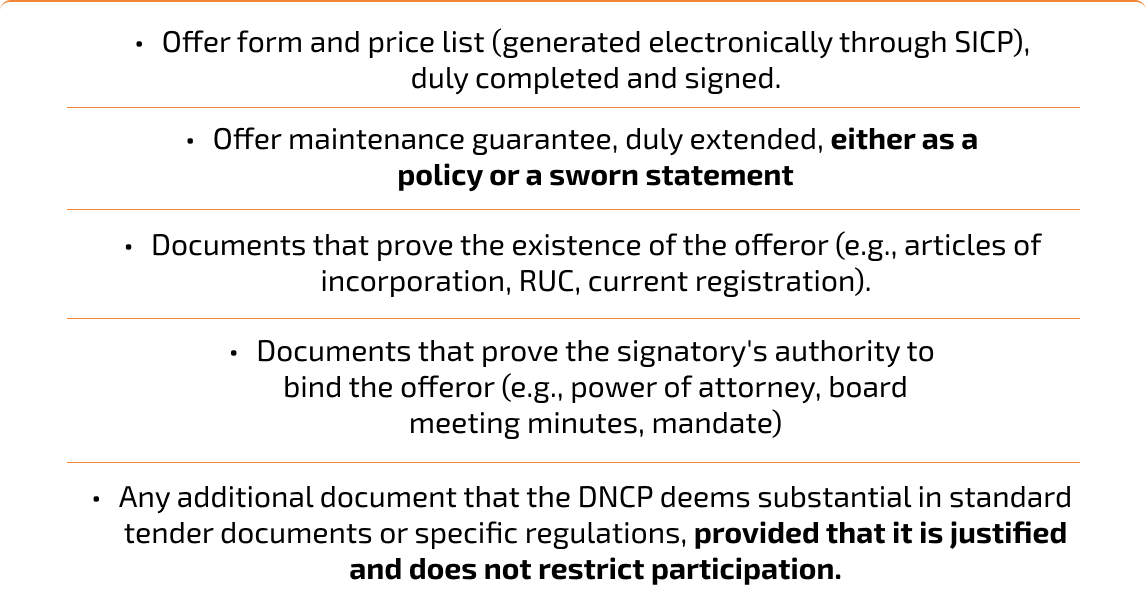
The documents required to submit a bid are classified as substantive and formal. Substantive documents are those that must be submitted with the bid on the date and time set for the opening; that is, they cannot be amended or corrected after submission, and if they are omitted, they cannot be submitted subsequently.
These documents form the core of the offer and guarantee its legal and economic validity. The omission, absence, or non-compliance with these documents will result in the automatic rejection of the offer.
What are the essential documents?
ㅤ
- In physical bids, the substantive documents must be included with the bid and duly signed on every page. In the case of a bid security, it must be properly issued, and if a guarantee is provided through a sworn statement, this statement must be signed and accompanied by its certified signature.
- In electronic bids, upon completion of the bid upload and submission, any document uploaded or linked to the electronic bid is considered to be electronically signed.
ㅤ
- What are the formal documents required for submitting bids?
Formal documents are those whose omission or error does not affect the essential validity of the offer nor alter the fundamental conditions (unit prices, scope or quality)
They can be corrected at the request of the convener within the established period.
ㅤ
- What are the formal documents?
The standard does not establish an exhaustive list, but rather indicates the criteria for identifying whether a document or error can be considered formal:
- It does not affect the substantial conformity of the offer.
- It can be remedied without altering the equality between bidders.
- It does not modify unit prices or essential conditions.
Examples include:
- Folio errors, numbering or lack of copies.
- Expired administrative certificates or records that can be updated.
- Transcription errors or errors in data loading that do not alter unit prices.
- Arithmetic errors in calculations (corrected by maintaining unit prices).
ㅤ
- Who evaluates the bids?
The convening institutions have Bid Evaluation Committees, whose members must be appointed by the highest institutional authority and have sufficient suitability.
It is up to each institution to decide whether to form a committee for each tender or to have a permanent committee.
The evaluation of bids must be carried out based on the criteria and parameters established in the tender documents and in accordance with legal regulations. The Committee is not permitted to evaluate based on criteria or conditions not established in the tender documents.
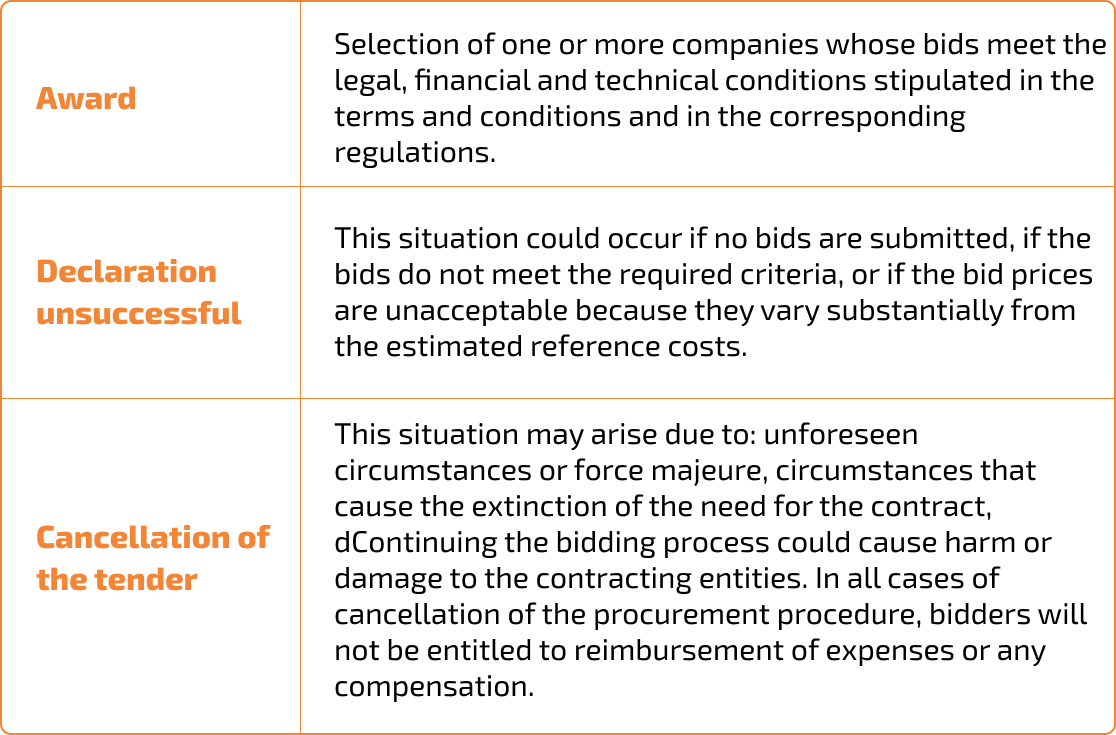
Offers that do not meet the established conditions will be disqualified, and this must be stated in the evaluation report and in the administrative act of award, declaration of void or cancellation, the grounds for the decision.
The evaluation report is not binding; that is, the highest institutional authority may or may not decide on the award following the Committee’s recommendation. However, if the authority deviates from the recommendation, it must provide a duly justified reason.
ㅤ
- What results can be expected after the evaluation?

ㅤ
- What is a protest?
A protest is a legal recourse that can be filed against the terms and conditions or against the award, that is, it can be filed with respect to any administrative act within the framework of a bidding process.
In other words, it is the presentation by virtue of which interested parties can express, denounce or challenge before the DNCP acts that contravene the provisions of this Law at any stage of the contracting procedures.
ㅤ
- How to file a protest?
The protest must be submitted using a form available in the Electronic Legal Procedures System (STJE). For further details, interested parties can consult the guides available on the DNCP portal.
ㅤ
- What are the minimum requirements for filing a protest?
- Information of the person making the protest: name and surname, address, telephone number, email address and indication of the capacity in which they are appearing.
- Conclusive documentary evidence of the representation invoked.
- Precise name of the convening entity.
- Contracting procedure details.
- Precise designation of what is being challenged.
- Proof of the legitimate interest invoked.
- Demonstrate that the challenge is filed within the prescribed time limit.
- The facts on which the request is based, clearly explained.
- The law briefly explained.
- The request in clear and positive terms.
- Attach the documentary evidence or indicate the office or place where it is located and offer the other evidence established in art. 192 of Decree No. 2264/24.
ㅤ
- At what stage can a protest be considered?
The protest may be filed within the framework of a hiring process:
- Before the submission and opening of bids against conditions imposed in the terms and conditions document (PBC) and call for bids.
- At the end of the bidding process, against the outcome of the call, that is, against the award, declaration of no bid, cancellation or prequalification.
ㅤ
- What are the deadlines for filing protests?
In the case of presentation ofprotest before the submission and opening of bids, that is, against the terms and conditionsThe company may file the protest from the date of publication of the tender or addendum until:

In the case of the presentation ofprotests against the outcome of the biddingBidders may protest:

ㅤ
- What are news audiences?
Once the result of a tender has been notified, any bidder who participated has the right to request a hearing so that the convening entity can explain the grounds that motivate the decision regarding the analysis of the offer.
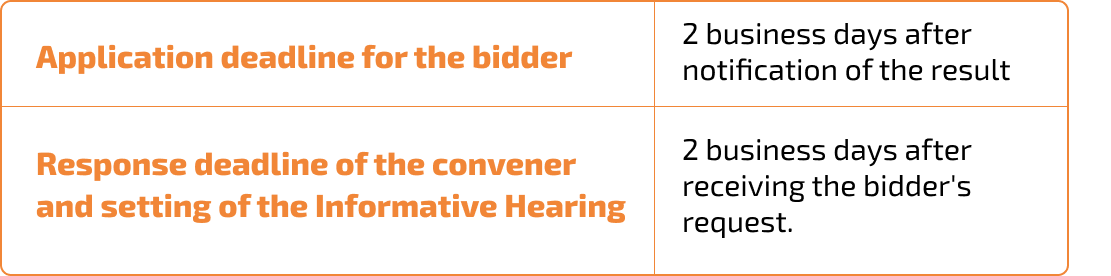
The request for an informational hearing will not suspend or interrupt the deadline for filing protests.